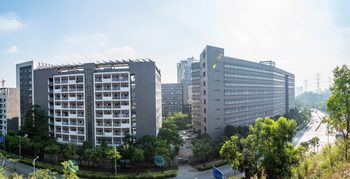


In our “Factories of China” series we are looking deeper into what kind of factories you might be dealing with in China. Doing comprehensive due diligence about what type of company you are dealing with and where these factories usually are found.
Floor factory in China
We have named these kinds of factories “floor factories”. Just because the factory is located in a building and occupying only a floor or a part of a level called a unit. A floor factory in China is typically related to a small business such as start-ups or SME’s. Mostly located in by government-appointed industrial area’s.
Factory buildings with floor unit rentals
Factory buildings with floors or part of levels for rent for industrial purposes have smaller units for rent. Different kind of units with a different amount of square meters suiting the stage of development of smaller companies. Units that are suitable to start or grow a smaller factory/workshop step by step.
How to recognise a Floor factory?
As we assume you are not able to easily visit a factory in China, you will need to surrender yourself to the online information available. Especially because pictures and information published online by factories are not always that transparent and reliable. However, the address and location of a factory are more often transparent and trustworthy. From the address, you can recognise and estimate if you are dealing with a Floor factory or related.
For example, every full written address will have a floor number:
4/F, B Building, No. 8 Eastern Zone, Shangxue Technology Park, Bantian, Longgang, Shenzhen.
To recognise a unit, you will often find that a room number is added to the address. Especially a number which would be a logical order of numeration could indicate a unit. Also if there is an A/B/C added to the room number.
No 406, 4th Floor, Bldg. 4, Dafapu Industrial Zone, Bantian, Longgang, Shenzhen, Guangdong, China (Mainland)
Here you can recognise that number 406 could be a logic number for “4th floor and room number 6”. Indicating that there are at least 6 units on the 4th floor.
**Sometimes factories are publishing an incomplete address. Advised is to ask or look for a Chinese address and check the location in a Chinese online platform.
Infrastructure for SME’s and economic growth
Rental prices are lower, and therefore investments are lower. A company is therefore not required to rent a full factory building causing high costs and risk. Providing an infrastructure for SME’s in a country to develop a business and economic growth. These factory buildings have different kind of square meter units and are therefore attractive for SME’s.
High density of factories and people
Most of the floor factories located in cities and towns with a higher density of factories and people. For the same reason that apartment buildings are preferred over regular houses, factories also are built as storey buildings to occupy more companies on the same amount of land. More factories located at one location will increase job availability causing more (migrant) workers to move to those locations.
Available labour at these locations
In a growing economy and growing cities, the demand for labour is high. Resulting in attracting more people with different needed skills to a specific area. Making it a beneficial place in terms of Human Resources. A smaller factory should be flexible in hiring workers. To establish growth they will need to recruit fast and the right skilled labour. They need a location with a higher amount of skilled factory workers. Renting a factory in this kind of places is therefore beneficial for SME’s.
Production lines of floor factories
Every company is different. However, we find in our experience that Floor factories usually are not having professionalised factories. You can also not expect a professionalised factory just only based on the fact of their development stage as a company. Smaller workshops in Europe also will not have professionalised production lines.
Temporary production layout per order/project
Production lines in Floor factories are mainly existing out of one or more assembly tables and/or a few machines. Comparable with a workshop, workers will work based on a project model where the production manager will create a temporary layout of production stations and appoint those stations to the available workers. Different per order and product. There are no standard production procedures, stable product quality standards, standard quality control units or workers executing the same daily tasks. Creating an unstructured production and causing risk of quality failures.
Difficulties found with Floor factories
For a lot of products, floor factories are suitable. There will be factories found who can produce a compliant product and also factories who can’t. Based on a physical judgement of the product and production way this can be judged. The most faced issue found with Floor factories is the difficulty in solving quality problems, improving and stabilise quality.
No standard processes in production lines
Because there are no standard processes in the production line, there are also no standard references to workers. There is no standard quality reference or productivity reference. A worker doesn’t know if they do their work well based on a clear horizon but just by their own opinion. When a low-cost factory worker in China is going to decide for a high-cost client in Europe whether a product is compliant or not you need to expect problems.
No standard Quality Control (QC) stations
Because there are no standard QC stations involved, there is no clear record per process about what issues found and what the origin of these quality issues could be. The source of functional problems of an electronic product is for example hard to track down without knowing your processes well and detailed.
Difficulties when improving quality
To improve quality, you will need to find the source of the problem. If there are no structured recordings of structured processes, it is complicated to find the source of the problem and implement a solution for it. As every production can be different from people, resources and parts a solution of today can tomorrow become not relevant anymore.
Informed choosing a Floor factory
Creating awareness of what a Floor factory is and what its capabilities are facilitating you to make an informed decision about whether to work with a Floor factory or not. For many kinds of products, companies or situations a Floor factory is sufficient. But it has its limitations which are needed to be highlighted.